
About Polmuz Drums

A Polish drum brand
Polmuz is a Polish drum brand that was born in Warsaw in the 1960s and now lives in Gdynia. Under this name we make four drum kit models, snare drums and cymbals, and we build custom kits from scratch in our own workshop. Below I tell you where we come from and what happens to a drum before it reaches you.

From Grochowska Street to Gdynia
The first drums with the Polmuz logo left a Warsaw factory at 75/77 Grochowska Street in the 1960s. In communist Poland they were made from whatever was available, so shells came out of alder, birch or pine, and sometimes out of fibreboard or hardened cardboard. The so-called “Everplays”, assembled under licence from the British company Premier, were noticeably better. Mateusz Wysocki, writing about the history of Polish drums, put it as a question in his headline: was Polmuz an “immortal enemy, or the saviour of young drummers”? The answer depended on which kit you ended up with, but a great many Polish drummers started out on one. The last drums left the line in the early 1990s and the brand went quiet for a long time.
I founded the DrumStore shop on 9 January 2006, in a basement. I sold single Istanbul cymbals and drum kits, and at first I was the only person working there. The shop grew over time, and next to it we set up a workshop where we repaired and restored drums of every brand you can think of. Once you have taken apart that many other people’s kits, you quickly start to see where a maker took care and where they cut corners.
In 2018 we bought the rights to the Polmuz name. We kept the name and the classic logo from the old drums, and redesigned everything else, from the plywood to the hardware, using what we had picked up at the workbench. We showed the first new kits on 13 November 2019 at the Sfinks700 club in Sopot, where they were played by, among others, the drummers of Illusion and Lipali, Wojtek Warmijak and Paweł Osicki.
I show the whole premiere presentation, slide by slide, in the post The history of Polmuz in slides (in Polish).


Four drum kit models
Model 4 costs about PLN 3,200 and comes complete: drums, stands, cymbals and a throne, ready to play the moment you take it out of the box. The shells are birch rather than poplar, which is often used in kits at this price to keep costs down. Birch lets you cut a proper bearing edge, and the edge decides whether the head sits well and whether the drum can be tuned at all.
Model 3, at about PLN 4,300 without cymbals, is also birch but gets better hardware, a double-chain bass drum pedal and tom mounts that leave the shell undrilled and hang from a stand rather than from the bass drum. It is finished in lacquer, either in shaded fades or in transparent black. We manufacture Models 4 and 3 in China, under our own brand and our own quality control. We are open about it, because at this price almost every drum kit is made that way, and what comes out of the factory depends on the wood, the edge and the hardware you order from it.
Model 2 and Model 1 are built in our workshop in Gdynia, and these are proper custom kits: you choose the wood, the colour, the drum sizes and the hardware. Both models use the same wood and the same solutions inside the shell. Model 1 gets heavier-duty hardware, meaning stronger lugs, claws, legs, mounts and holders, Evans heads as standard and more of our time on every detail. Model 2 starts at about PLN 5,500 for a 20/12/14 kit in natural wood, Model 1 at about PLN 6,000, and the most elaborate Polmuz we have built so far cost PLN 40,000.
Alongside the kits we make snare drums, starting at PLN 999, and B20 bronze cymbals, hand-hammered in Turkey. I have described all the models, with prices and photos, in the guide How much does a drum kit cost and which one to buy.


How we build our drums
The most important parts of a drum are hidden under the head and inside the shell, so you won’t see them in product photos. Everything I describe below applies to the drums from our workshop, that is Models 1 and 2 and our snare drums.
Plywood
In 2019 I ordered plywood in different thicknesses and ply counts and listened to how bare shells made from each of them sounded. In maple the winner was a six-ply sheet, 4.8 mm thick, which gives a long, clean note when you tap it with a finger. A piece of wood that goes dead the moment you hit it will not start singing just because you put a head on it. The thinner wall also has a very down-to-earth advantage: the kit weighs less, and drums get carried to every gig.

Bearing edge
Right next to the hoop a drumhead is curved, and only further in does it flatten out. Our 2×45° edge meets the head exactly on that flat part, which is why the drum tunes low and holds its tuning longer. We arrived at it by building about ten shells with different edges and comparing them by ear, and the winner was the edge we knew from vintage drums. We cut every edge, polish it smooth and wax it, so the head slides over it instead of catching. A shell with a well-cut edge, laid on a sheet of glass, lets no light through anywhere, and you cannot slip a piece of paper under it. Anyone who comes to the workshop gets a shell in their hands and can run a finger along the edge.


Drilling
I trained as an engineer and used to design ships, so I lay out the lug holes in QCAD the way you draw the flat sections of a hull, on the unrolled surface of the shell. A shell is never a perfect circle, it is often a slight ellipse, and lugs from different makers have different hole spacing, so only a precise drawing lets us keep the hole layout within 0.2 mm. That precision has a very practical purpose. If the lugs sit crooked in relation to the edge, the tension rod does not enter the hoop hole straight, it rubs, and the drum becomes hard to tune. We drill with good step drill bits, because the difference between them and a five-zloty bit shows in every hole.
Tension rods and tuning
The tension rods on our drums turn easily and don’t rub against the hoop, and the shell is very slightly undersized, so the edge settles nicely under the head. In practice you tighten all the rods with your fingers to the same tension and the drum already sings, without tuning to a piano or hunting for a note at every rod. Tuning by feel, the finger-tight method, is in my opinion the quickest way there is, but it only works on a drum where everything has been made evenly.


Inside the shell
Every shell is oiled and waxed inside at no extra cost, so the wood can breathe and moisture stays out. It is the same reason nobody paints a wooden house with polyurethane. For an extra charge we do it a second time and assemble the drum with stainless steel screws, the kind used in shipbuilding, instead of cheap black screws that start to rust from the first scratch. Strictly speaking these are options, but practically every customer takes the stainless screws and most take the double waxing, which is no surprise, because with both the kit is close to indestructible. Inside every shell we also put a label with the serial number, the signature of the person who checked the drum and the owner’s name.
Snare drums
On Model 1 snares the throw-off pulls the snare wires 14 mm away from the head, while a typical one moves them about 7 mm. You hear those few millimetres when you play the snare like a tom. With a shallow throw-off the released wires keep vibrating with the head, buzz in quiet passages and answer every rimshot, while with a deep one they go completely silent. It matters most in recording, because that buzz cannot be cleaned out of the microphones afterwards.


Finishes
I believe drums are the most spectacular instrument on stage, and it is a shame to hide them at the back as a backdrop for the rest of the band, which is why we spend so much time on finishes. You can bring us your colour on any sample and we will match it with a spectrometer, by measurement rather than by eye. We apply most colours thinly, in oil and wax, because a thick coat of paint chokes the shell, and a drum should sound as good as it looks.
Over the years we have settled into five painting styles. Since 2020 we have been doing oil and wax fades, hand shading with no spraying and no lacquer, in which the colour fades out into natural wood. We use the same technique for solid colours, and flat black is the one people order most.
The most art goes into what we call our “maziajki”, a Polish word for smudges or daubs, which we have been painting since 2022 with a brush and oil paint. The movement of the hand stays on the shell just as it does on a canvas, and since there is no stencil for it, no two kits have ever come out the same.


In 2024 we added folk ornaments, poppies, cornflowers and sunflowers on a white fade, designed like a textile pattern and spread across the whole kit. In 2026 we started airbrushing with stencils drawn in CAD, including an “oyster” wrap look recreated in lacquer. The fifth direction is classic lacquer, with saturated colours, colour transitions and shading on bubinga that brings out the grain.
Apart from the colour, you choose the shell material (maple, birch, bubinga, walnut, acrylic or metal, meaning copper and aluminium, raw or aged), the size of every drum, the type and colour of the hardware, and an inlay, a one-millimetre strip set into a groove milled in the shell. A band logo or any artwork can go on the shell or on the resonant head.


The Philharmonic, the army and a rocket
In 2025 we built a six-piece kit for the Warsaw Philharmonic (Filharmonia Narodowa) in 4.8 mm European maple, with a hand-applied fade in oil and wax and not a drop of lacquer. For that job we developed a way of polishing the wax that brings out the grain. Two years earlier we made two kits for the Polish Armed Forces: a white-and-red one with an inlay milled into the shell and a red one with artistic painting, both with the national emblem painted by hand on the heads.


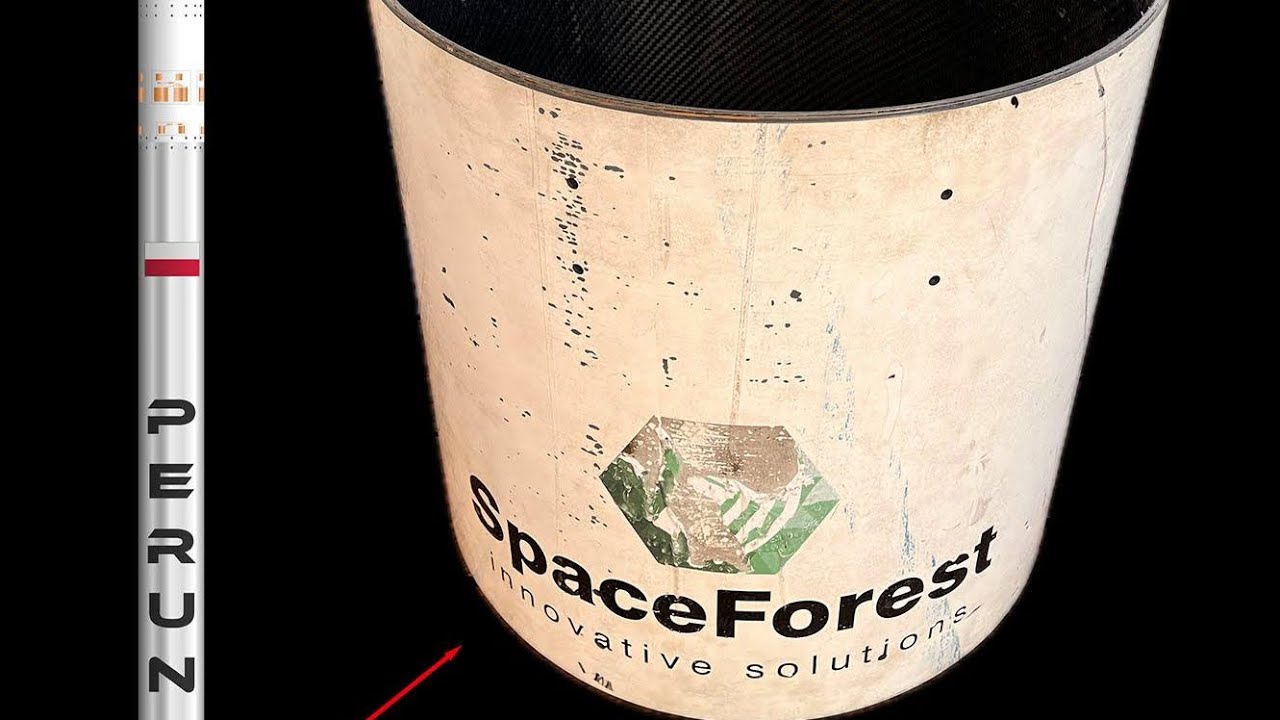
The most unusual material came from SpaceForest, a Gdynia company that builds the Perun suborbital rocket a few kilometres from our workshop. In 2024 we received the SF-1000 engine chamber and airframe sections from the prototype, which could not fly again after launch. We turned the chamber into a snare drum and the airframe into a bass drum, and these were the first drums in Poland made from rocket structure. Nobody had worked that kind of composite as an instrument maker before, so we worked out the edge angle, the wall thickness and the hardware mounting by testing on offcuts. The drums played at the Sopot Molo Jazz Festival, and in April 2026 they were on stage at the 3rd Drum Marathon at the Academy of Music in Gdańsk.


Who plays Polmuz
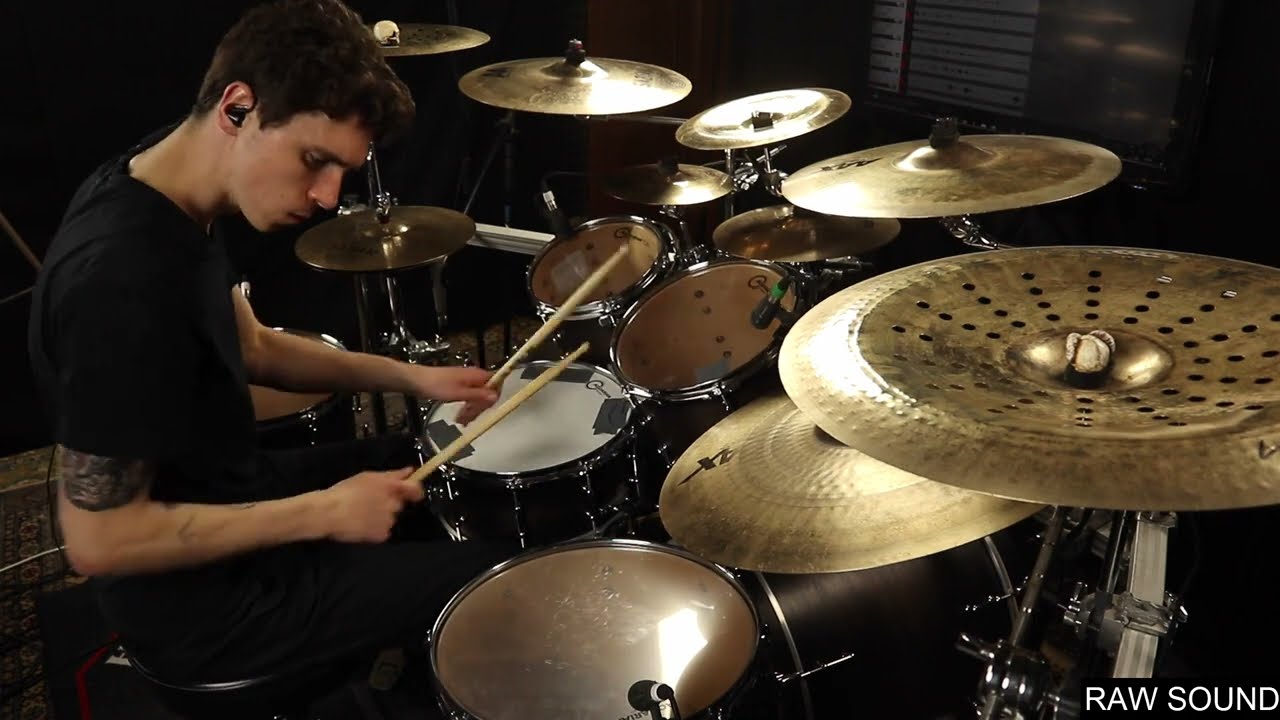
Polmuz kits get played in small clubs and in the philharmonic hall alike. Krzysztof Klingbein (Belphegor) has a double bass drum Model 1 in maple, finished in a satin black fade. Paweł Osicki (Pogodno) and Klaudia Rucińska (Sinfonia Baltica) play a Model 2 Maple, Mariusz “Nosek” Noskowiak of Blenders plays an acrylic Model 2, and Piotr Szpalik (Polish Metal Alliance) plays a Model 1 Maple with an inlay. You will find the full list, with bands and kits, on the They Play Polmuz page.
Ordering and care after you buy
A custom kit starts with a conversation, over the phone or at our workshop at Szczecińska 38 in Gdynia, where by appointment you can see finished kits and look inside the drums. A build usually takes one to four months, and up to eight for elaborate paintwork, because hand painting and waxing cannot be rushed. Along the way we send you photos from each stage, so you can see your instrument taking shape. You buy directly from us, with no distributor in between, which is why we can use better components at this price.
We give a lifetime warranty on the shell to the first owner, covering both plywood and metal, on all models from 1 to 4. Hardware and stands are covered for 36 months, acrylic shells for 24 months. We keep spare parts in stock, so a lost screw or a cracked lug means a parcel from us, not a hunt for something that more or less fits.
After you buy, you keep talking to the people who built your drum. We help you choose heads, set up the hardware and tune the kit, we do full servicing, and in our restoration workshop we also bring drums from other brands back into shape. Since 2006 more than two hundred drums have passed through our hands. In the Tricity area we also run a rental service for drum kits and other instruments for concerts, weddings and recording sessions.
Tomasz Stukan


